
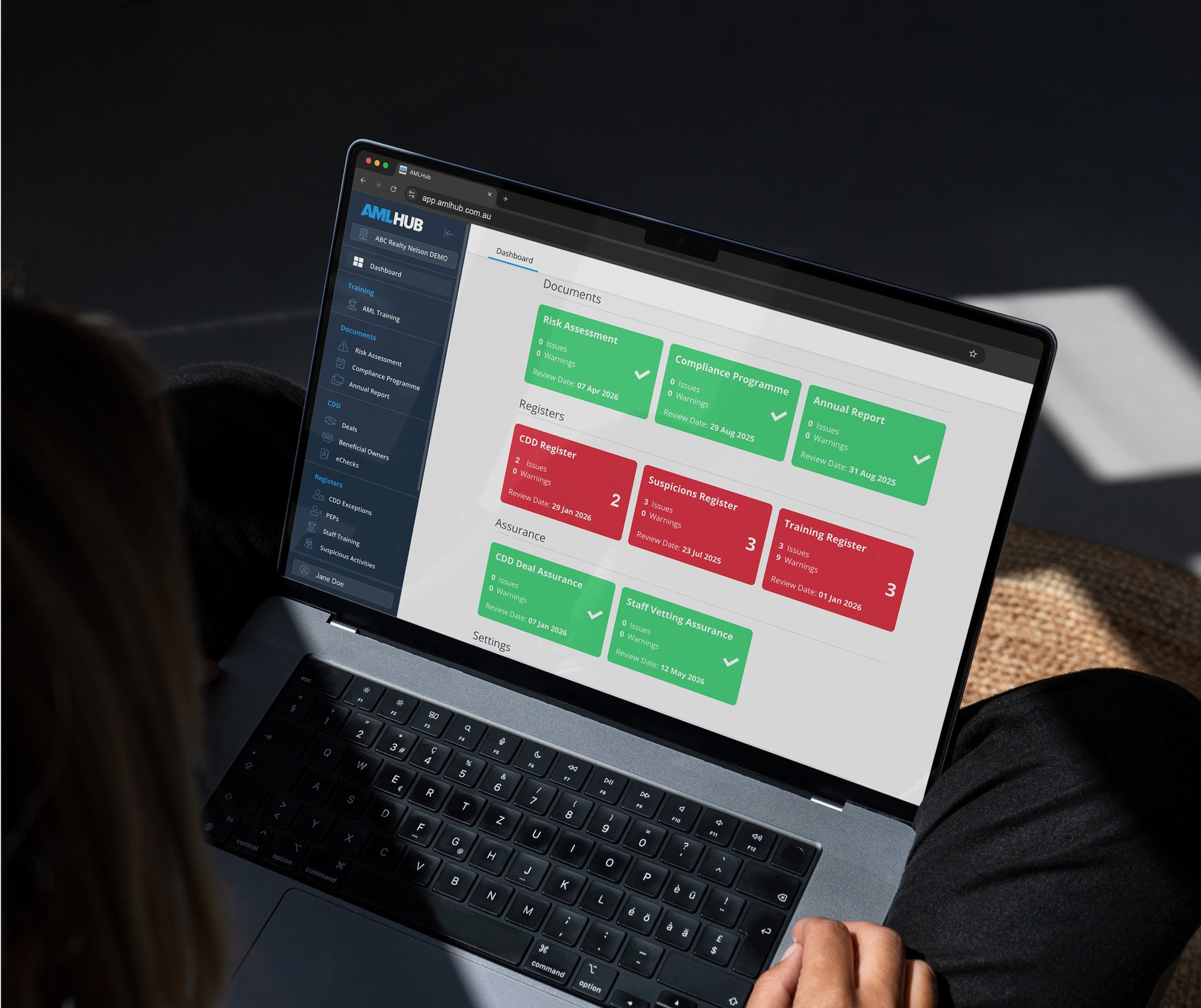

A complete AML solution for Australian Law Firms.
From 1 July, captured legal practices must comply with the AML/CTF Act. AMLHUB provides an end-to-end platform covering key compliance documentation, client due diligence / KYC, reporting, and ongoing compliance - ideal for Law Firms.
A complete AML solution for Accountants.
From your first compliance documents to ongoing reporting, AMLHUB brings together everything your practice needs to meet its AML obligations, all in one place.
Why Law Firms
choose AMLHUB's solution.
Relevant
Built for Legal AML workflows.
Relevant
Developed in 2018 to support best-practice AML onboarding and compliance management. Structured around real-world AML/CTF processes used by professional services firms.

Easy
Straightforward to implement.
Easy
Intuitive interface with minimal training required. More than 10,000 users rely on AMLHUB to manage their AML obligations efficiently.

Scalable
Flexible across firm structures.
Scaleable
Suitable for sole practitioners, partnerships, and multi-office firms. Add branches, users, and roles as your practice expands.

Centralised
Keeps everything compliant and audit-ready.
Centralised
Store your AML/CTF documents, KYC records, and reports in one system - ensuring continuity and clear audit trails.

"AMLHUB has made managing our AML obligations so much easier. The platform is clear, organised, and easy for our team to use day to day. Their CDD outsourcing service saves us hours on client onboarding, and the consulting support gives us confidence that we’re staying fully compliant."
Helen Edwards
AML Compliance Officer
K3 Legal
AML/CTF Obligations for Law Firms
Law practices providing designated services under the AML/CTF Act must implement and maintain a compliance AML framework. Key obligations include:
Establish and maintain an AML/CTF program
Captured firms must develop a documented AML/CTF program tailored to their specific risk profile. This includes policies, procedures, and controls to identify, assess, and manage money laundering and terrorism financing risk. The program must be reviewed periodically and updated as circumstances change.
Conduct Customer Due Diligence (CDD/KYC)
Before providing designated services, firms must verify client identity. This includes:
-
Confirming individual or entity identity
-
Identifying beneficial owners
-
Understanding source of funds and source of wealth where required.
Enhanced due diligence applies to higher-risk matters or clients.
Ongoing Client Monitoring
Firms must monitor client relationships and transactions throughout the engagement. This involves identifying unusual behaviour, inconsistencies with the client risk profile, and material changes in ownership or control.
Suspicious Matter Reports (SMRs)
If a firm forms a suspicion of money laundering, terrorism financing, or related criminal conduct, it must lodge a report with AUSTRAC within the prescribed timeframes (generally within 3 business days, or 24 hours for terrorism financing concerns).
Other reports (e.g. TTRs, EFTIs)
Where applicable, firms must report cash transactions exceeding $10,000 and certain cross-border funds transfers.
Staff training
Relevant staff must receive ongoing AML/CTF training appropriate to their role. Training records must be retained.
Independent Evaluation
An external independent evaluation of the AML/CTF program must be conducted at regular intervals to assess effectiveness and compliance.
Want to see how it works?
Resources
AML/CTF Terminology Guide for Law Firms
Understand the key terms used in Australia's AML/CTF regime, including SMRs, CDD, KYC, beneficial ownership, and designated services.
Download our practical reference guide.
See how AMLHUB will support your AML compliance.
Book a walkthrough and
we’ll show you how AMLHUB
fits into your firm's workflow.
